Ebac Dehumidifier (2026)
By Priya Shah, reviewed by James Whitfield · Updated
Every Ebac model we've compared — the only dehumidifier brand still manufactured in Britain, built for the UK climate with Intelligent Defrost.
Why buy an Ebac dehumidifier
Ebac is the only dehumidifier brand still manufactured in Britain, at the company's factory in Newton Aycliffe, County Durham — every other major brand sold on Amazon.co.uk, including Meaco and Pro Breeze, is designed abroad and assembled in Asia. That single fact shapes almost everything else about the brand: Ebac engineers specifically for the UK's damp, cold, changeable climate rather than a generic global market, and it prices accordingly.
The clearest expression of that UK-first engineering is Intelligent Defrost, Ebac's proprietary technology that keeps the compressor working effectively down to 3°C. Most compressor dehumidifiers — including many Meaco and Pro Breeze models — start losing extraction efficiency below roughly 10°C and effectively stop working below 5°C, because frost builds up on the coils faster than a standard defrost cycle can clear it. A cold hallway, an integral garage, a single-skin Victorian extension or an unheated static caravan over winter are exactly the situations where a standard compressor unit disappoints and an Ebac keeps pulling moisture out of the air.
The second thing every Ebac owner mentions, almost without exception, is longevity. Trawl through the verified Amazon.co.uk reviews on Ebac's range and it's common to find buyers replacing a unit after 8, 14, even 30 years of continuous use — not because it broke, but because they wanted the newer Smart Technology or a bigger tank. That kind of reported lifespan is unusual in small appliances generally, and it's the main reason Ebac can justify sitting above Meaco and well above Pro Breeze on price: buyers are paying for a machine built to outlast two or three cheaper replacements.
None of that makes Ebac the automatic right choice for every buyer. It comes with real trade-offs — a shorter 2-year warranty against Meaco's 5, no Wi-Fi or app control on the current 2650E, and a smaller pool of Amazon ratings than the higher-volume Meaco and Pro Breeze ranges. The rest of this guide goes through exactly who that trade-off suits, and who should look at Meaco or Pro Breeze instead.
How Intelligent Defrost actually works
Every compressor dehumidifier pulls moisture out of the air by passing it over a cold coil, which condenses the water vapour into liquid — the same principle as a fridge. The problem is that once room temperature drops much below 10°C, moisture starts freezing onto that coil faster than it can drain away as water, building up a layer of frost that blocks airflow and steadily kills extraction performance. A basic compressor unit handles this with a simple timed defrost cycle: the compressor pauses on a schedule regardless of how much frost has actually built up, which wastes time in mild conditions and isn't aggressive enough in genuinely cold ones.
Ebac's Intelligent Defrost instead reacts to the coil's actual condition rather than a fixed timer, triggering a defrost cycle precisely when ice is forming and running it only as long as needed. That's the mechanical reason Ebac can quote a 3°C minimum operating temperature where most rival compressor units effectively stop being useful somewhere between 5°C and 10°C. In practical terms, it's the difference between a dehumidifier that keeps clearing damp air in an unheated garage through a cold snap, and one that ices over and stalls.
It's worth being precise about when this matters. Above roughly 15°C — a normally heated living room, bedroom or kitchen — Intelligent Defrost isn't doing much extra work, because a standard compressor unit is already operating well within its comfort zone. The advantage shows up specifically in the 5-10°C range: an integral garage, an unheated hallway, a porch, a static caravan left over winter, or an old single-skin extension. If none of your rooms fall into that bracket, this particular Ebac advantage shouldn't weigh heavily in the decision — warranty length, price and smart features matter more.
The Ebac 2650E, model by model
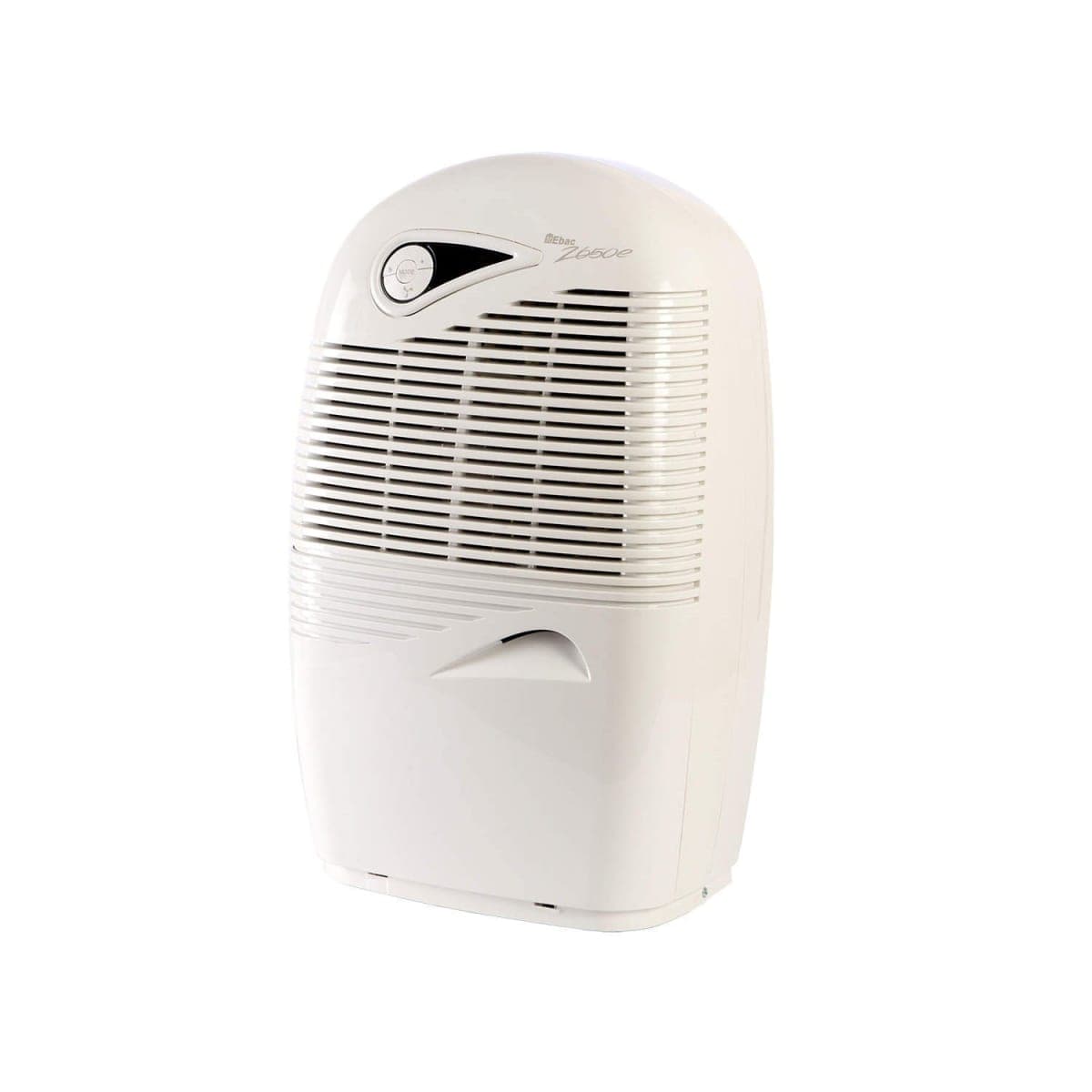
At the time of writing, the model we've sourced and verified from Ebac's range is the Ebac 2650E, an 18 litres/day compressor unit positioned as the brand's mid-size, all-rounder model — big enough for most UK homes up to four bedrooms, without the bulk or price of Ebac's largest units.
Three features define it beyond the Intelligent Defrost already covered above. Smart Technology switches the unit on and off automatically once it senses excess moisture, rather than running flat-out on a timer — Ebac's own figures put the running-cost saving at up to £50 a year versus a basic humidistat-controlled dehumidifier, which matters given the 2650E's higher upfront price. An 8-hour laundry drying boost is built in for indoor drying, matching the dedicated laundry modes on the Meaco Arete Two and Pro Breeze OmniDry. And an air purification mode runs alongside dehumidifying, which none of the Pro Breeze models in our comparison offer.
Set against that, the 2650E's 2-year parts-and-labour warranty is noticeably shorter than the 5 years Meaco puts behind both the Arete Two and Arete One, and there's no Wi-Fi or app control — a feature the Meaco Arete Two and the Pro Breeze 20L OmniDry both include. At £315 it's also the most expensive 18-20L compressor unit across the models we've compared, sitting above the Meaco Arete Two (£299.99) and well above the Pro Breeze 20L OmniDry (£189.99).
Read the full Ebac 2650E review for the complete specification table, pros and cons, and our detailed verdict on who it suits.
Running cost, worked through. Ebac states its Smart Technology can save up to £50 a year versus a basic humidistat-controlled unit run continuously. Over a 2-year warranty period, that's up to £100 clawed back against the 2650E's £315 asking price; stretch it across the 8-14 year lifespans long-term owners report in Amazon reviews, and the saving comfortably outweighs the higher purchase price versus a cheaper rival — provided the unit is actually left in Smart/auto mode rather than run manually on full power around the clock, which is where the saving comes from in the first place.
Where the 2650E is a poor fit. If you want to control the dehumidifier from your phone, set schedules remotely, or check tank status without walking over to the unit, the 2650E simply doesn't offer it — that's a real, current gap against the Wi-Fi-enabled Meaco Arete Two and Pro Breeze 20L OmniDry, not a matter of interpretation. Buyers for whom app control is a hard requirement should treat that as disqualifying regardless of how the rest of the spec sheet compares.
What to check before buying an Ebac dehumidifier
Sizing. As a rule of thumb, 10-12 litres/day suits a flat or a 1-3 bedroom house, while 18-20 litres/day — the 2650E's bracket — covers homes with up to four bedrooms or particularly damp properties. If you mainly want to dry laundry indoors rather than tackle general damp, it's worth sizing up rather than down; a laundry-drying boost works faster and more thoroughly on a higher-capacity unit.
Minimum operating temperature. This is the single most important spec Ebac buyers should check, and the one most comparison sites skip. A standard compressor dehumidifier stops being effective somewhere between 5°C and 10°C. If you need a unit for a cold hallway, an integral garage, a porch or an unheated outbuilding over a British winter, Ebac's Intelligent Defrost — rated down to 3°C — is doing real work that a cheaper compressor unit simply can't match. If every room you're dehumidifying is normally heated above 15°C, this advantage matters far less, and price and warranty should carry more weight in the decision.
Running costs. Ebac's Smart Technology and Meaco's equivalent auto on/off sensing both exist for the same reason: a dehumidifier left running continuously on a timer wastes electricity once the air is already dry. Ebac's own estimate of up to £50/year saved by Smart mode versus a basic humidistat unit is a reasonable planning figure — it partly offsets the 2650E's higher purchase price over a multi-year ownership period, though it won't close the full £100+ gap versus the cheaper Pro Breeze 20L OmniDry in year one.
Warranty. Ebac's 2-year parts-and-labour cover is shorter than Meaco's 5 years on the equivalent Arete Two and Arete One. On paper that looks like a weakness — but it sits oddly alongside the real-world longevity reports from long-term Ebac owners running units for a decade or more past any warranty period. Treat the warranty length as a measure of the manufacturer's own confidence window, not as a hard ceiling on how long the unit will actually last.
Noise and where you'll use it. None of Ebac's current range currently ships with a dedicated ultra-quiet mode in the way Meaco markets its "Low Energy" and quiet settings, though the 2650E does include a 2-speed setting with a quieter low mode. If the dehumidifier needs to run overnight in or near a bedroom, weigh this against the Meaco Arete range, which we cover in the best dehumidifier for bedroom comparison.
Smart features. If app control, scheduling or remote monitoring from your phone matters to you, note that the current Ebac 2650E has none of it — that's a genuine gap against the Wi-Fi-enabled Meaco Arete Two and Pro Breeze 20L OmniDry. Ebac's pitch is mechanical reliability and climate performance over connected convenience; buyers who want both usually end up choosing Meaco instead.
Ebac vs Meaco vs Pro Breeze
Ebac vs Meaco. These are the two brands most often cross-shopped by buyers who've decided they want a genuinely durable, mid-to-premium dehumidifier rather than the cheapest option available. Meaco wins outright on warranty — 5 years against Ebac's 2 — and its Arete Two adds Wi-Fi app control that the Ebac 2650E doesn't have, at a lower price (£299.99 vs £315). Ebac's counter-argument is Intelligent Defrost down to 3°C (Meaco's equivalent threshold is less aggressive) and the fact that it's the only one of the two still built in Britain. For a cold garage or hallway, Ebac has the edge; for a warm, normally-heated room where warranty length and app control matter more, Meaco is the stronger buy.
Ebac vs Pro Breeze. Pro Breeze is the value play of the three — the 20L OmniDry undercuts the Ebac 2650E by over £120 and still holds a Which? Best Buy award, with Wi-Fi control included. What you give up against Ebac is the extreme-cold performance (Pro Breeze units aren't built around a defrost technology comparable to Ebac's) and, based on the pattern of long-term ownership reports across both brands, the multi-decade lifespan Ebac owners describe. Pro Breeze also carries only a 1-year warranty, the shortest of the three brands compared here.
The short version. Buy Ebac if you specifically need a unit that keeps working in a cold space down to 3°C, or if a British-made product with a strong long-term reliability track record matters more to you than the lowest price or app control. Buy Meaco if you want the longest warranty and Wi-Fi control at a lower price than Ebac, in a normally heated room. Buy Pro Breeze if budget is the deciding factor and you're happy with a shorter warranty in exchange for the lowest upfront cost.
What Ebac buyers say
Our verdict below draws on the pattern across verified Amazon.co.uk reviews and Ebac's own published customer feedback, cross-checked against the specification data on each model — the same approach we take across every brand comparison on this site.
The single most repeated theme in Ebac reviews, by a wide margin, is longevity. It's common to see five-star reviews from buyers explicitly replacing an Ebac unit that was still working after 8 to over 30 years, often citing that as the reason they bought another Ebac rather than switching brands. That kind of repeat-purchase loyalty, driven by a positive experience with a much older unit, is rare to see at this frequency for any small appliance category.
The most repeated criticism is price relative to the newer competition — buyers who compare the 2650E's spec sheet directly against a similarly-sized Meaco or Pro Breeze model, without factoring in Ebac's reliability track record, often note that £315 buys less on-paper features (no app, no Wi-Fi, shorter warranty) than a cheaper alternative. The 2650E's Amazon ratings sample is also smaller than Meaco's and Pro Breeze's higher-volume listings, which is worth bearing in mind when weighing star ratings against each other — a 4.6-star average built on a few dozen reviews carries less statistical weight than the same score across several thousand.
Which rooms actually need Ebac's cold-weather advantage
Integral garages. These typically sit at or below outdoor temperature for most of winter, and are one of the clearest cases where a standard compressor unit underperforms. Ebac's 3°C rating keeps extraction working through a UK cold snap where a Meaco or Pro Breeze unit would be icing over and cycling in and out of defrost.
Unheated hallways and porches. Often the coldest heated-adjacent space in a house, especially in older properties with a front door directly onto the hall. If damp or condensation collects there specifically — rather than throughout the whole house — an Ebac positioned in that space will keep working through the coldest months when it's needed most.
Static caravans and outbuildings left over winter. A dehumidifier left running in an unoccupied caravan or summer house through winter is precisely the scenario Intelligent Defrost was designed around: no heating, temperatures regularly at or below 5°C, and damp doing real damage if nothing is extracting moisture.
Normally heated bedrooms, living rooms and kitchens. In these spaces, temperature rarely drops anywhere near the 3-10°C range where Ebac's defrost technology earns its keep. See our dedicated dehumidifier for bedroom and dehumidifier for mould comparisons for room-specific picks — Meaco and Pro Breeze models often make more sense here on price and features alone.
Which Ebac dehumidifier should you buy
If you need a dehumidifier for a cold hallway, garage or unheated outbuilding over a British winter, the Ebac 2650E is the strongest pick in our comparison — Intelligent Defrost down to 3°C is a genuine, measurable advantage over standard compressor units in exactly that scenario.
If you want the longest possible warranty and app control, and your home is normally heated, look at the Meaco Arete Two 20L instead — 5 years of cover and Wi-Fi control at a lower price than the Ebac.
If budget is the main constraint, the Pro Breeze range will solve most damp and laundry-drying problems for considerably less money, with the trade-off of a 1-year warranty and no equivalent to Ebac's cold-weather defrost performance.
If you want a British-made appliance built for the long haul, and you're comfortable trading a shorter 2-year warranty and the absence of app control for a track record of decade-plus lifespans reported by real owners, Ebac remains the brand to choose — see our full best dehumidifier UK comparison for how it stacks up against every model we've sourced.
Frequently asked questions
Ebac dehumidifier reviews: what do UK buyers say?+
Ebac owners consistently mention longevity above anything else — it's common to see verified Amazon reviews from buyers replacing a previous Ebac unit after 8 to over 30 years of continuous use. The main criticism is the higher price and shorter 2-year warranty relative to Meaco's 5 years.
Is Ebac better than Meaco or Pro Breeze?+
Ebac is the only brand of the three still manufactured in Britain, and its Intelligent Defrost keeps it working down to 3°C — better suited to a cold hallway or garage than most compressor rivals. Meaco still offers the longer warranty (5 years vs Ebac's 2) and app control that Ebac lacks, so the right choice depends on whether longevity or smart features matter more to you.
Is the Ebac 2650E worth the extra cost over a Meaco or Pro Breeze?+
If you need a dehumidifier that keeps working in a cold garage, hallway or outbuilding down to 3°C, yes — that's a genuine mechanical advantage over standard compressor units. If every room you're using it in is normally heated above 15°C, a Meaco Arete Two gives you a longer warranty and Wi-Fi control for less money, and a Pro Breeze OmniDry gives you similar extraction for considerably less.
How much does Ebac's Smart Technology actually save on running costs?+
Ebac's own figure is up to £50 a year versus a basic humidistat-controlled unit run continuously, since Smart Technology switches the unit off once the target humidity is reached rather than running flat-out. That saving only applies if the unit is left in Smart/auto mode — running it manually on full power around the clock forfeits the benefit.
Does the Ebac 2650E have Wi-Fi or app control?+
No — the current 2650E has no Wi-Fi or smartphone app, unlike the Meaco Arete Two and Pro Breeze 20L OmniDry, which both offer remote control and scheduling. If app control is a requirement for you, that rules the 2650E out regardless of how the rest of the spec compares.
What's the minimum temperature an Ebac dehumidifier can work in?+
The Ebac 2650E's Intelligent Defrost is rated to operate effectively down to 3°C, well below the roughly 5-10°C threshold where most standard compressor dehumidifiers start icing over and losing extraction performance. Above about 15°C, this advantage matters far less, since a normal compressor unit is already well within its comfort zone.
Sources and further reading
Explore more dehumidifier guides
17 dehumidifiers compared · Amazon.co.uk prices checked October 2026