Moisture Absorber vs Dehumidifier: Which Do You Need?
A moisture absorber is a tub of crystals that costs a few pounds. An electric dehumidifier costs a hundred or more. They are sold for the same problem, but they work on completely different scales.
The short answer
A moisture absorber suits small, closed spaces: a wardrobe, a cupboard, a car, a caravan in storage. An electric dehumidifier is what you need for a room you live in. A tub of crystals collects a few hundred millilitres over several weeks. A compressor dehumidifier can collect that in an hour or two.
Moisture absorber vs dehumidifier at a glance
The figures show why one cannot stand in for the other.
| Moisture absorber | Electric dehumidifier | |
|---|---|---|
| How it works | Calcium chloride crystals absorb water | Compressor or desiccant wheel extracts water |
| Water collected | A few hundred ml over weeks | Several litres a day |
| Electricity | None | Roughly 4-9p an hour while running |
| Noise | Silent | 35-50 dB(A) |
| Ongoing cost | Refills every few weeks or months | Electricity only |
| Controls humidity to a target | No | Yes, with a humidistat |
| Best for | Wardrobes, cupboards, cars, stored caravans | Bedrooms, living rooms, whole homes, laundry |
What a moisture absorber can do
The crystals pull water vapour from the air and dissolve into brine in the tray. In a closed wardrobe or under-stairs cupboard that is enough to stop a musty smell and protect clothes and shoes. In a parked car it reduces misted windows. There is no noise, no power and nothing to set. A refillable model such as the Starwax moisture absorber keeps the running cost down.
What it cannot do
It cannot dry a room. A person breathing overnight releases more water than a tub absorbs in days, before you count showers, cooking and washing. If there is condensation on the windows every morning or mould on a wall, absorbers will fill up and the problem will stay. They also have no control: they keep absorbing until the crystals are gone.
The middle option: mini dehumidifiers
Small Peltier dehumidifiers, such as the Pro Breeze 500ml, sit between the two. They are quiet and cheap, and they suit a small bathroom, a box room or a large cupboard. They extract a few hundred millilitres a day, so they are not a substitute for a compressor model in a damp bedroom. Our small dehumidifier guide covers them.
Cost over a winter
A tub and its refills look cheap, but a home with several of them going through refills every few weeks spends steadily all winter and can still have wet windows. A 12L dehumidifier at about 3 to 5p an hour, running a few hours a day, costs a similar amount in electricity and removes hundreds of times more water. For one wardrobe, absorbers are cheaper. For a room, the dehumidifier is.
Safety and handling
The liquid that collects in an absorber is a salt solution. Keep tubs upright and out of reach of children and pets, empty them down the toilet or an outside drain, and wipe up spills, since the brine can mark fabric, metal and leather. Hanging bags suit wardrobes; flat tubs suit shelves and car footwells.
Where absorbers earn their place
They are at their best where a plug is not an option: a wardrobe on a cold outside wall, a caravan or boat laid up for winter, a classic car in a garage, a holiday let left empty. For a garage or workshop with power, an electric model made for cold spaces does far more: see our garage dehumidifier guide.
Which should you buy?
Musty wardrobe, damp car, stored caravan or boat: moisture absorbers, replaced on schedule. Wet windows, black mould, washing drying indoors, a bedroom that smells damp: an electric dehumidifier. For a flat, a 10L or 12L model is enough: see our budget picks. Both at once is common and sensible: a dehumidifier for the rooms, absorbers inside the wardrobes on the cold outside wall.
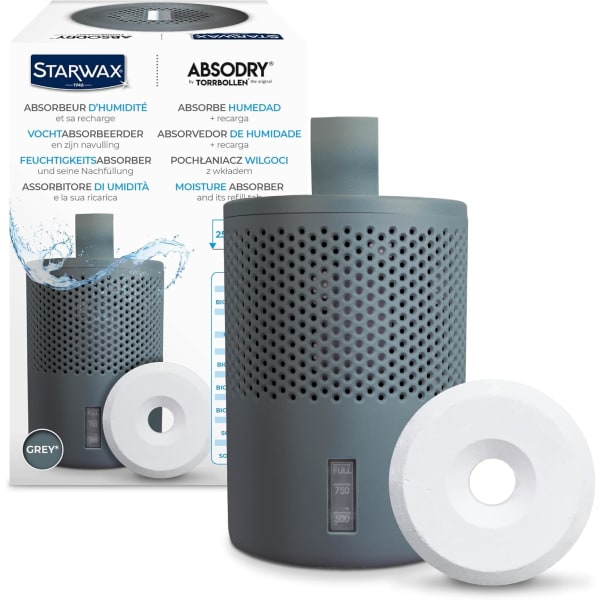
STARWAX Moisture Absorber Box 25 m² with 500g Tablet
Passive, no litres-per-day rating · 4.0/5

Pro Breeze 500ml Premium Mini Dehumidifier
Up to 250ml of moisture/day · 4.1/5
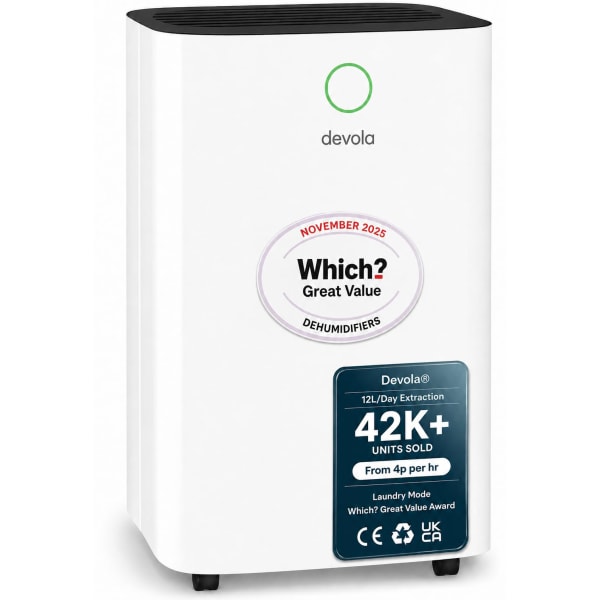
Devola DV12L Low Energy Dehumidifier
12 litres/day · 4.6/5
Ready to compare models? See our best small dehumidifier uk comparison →
Frequently asked questions
Do moisture absorbers work as well as dehumidifiers?
No. An absorber collects a few hundred millilitres over weeks, an electric dehumidifier several litres a day. Absorbers work in small closed spaces, not in lived-in rooms.
Are moisture absorbers worth it?
Yes, for wardrobes, cupboards, cars and stored caravans, where they prevent musty smells without power or noise.
Will a moisture absorber stop mould on walls?
Not in a room. Mould on walls means the whole room's humidity is too high, which needs ventilation, heating and usually an electric dehumidifier.
How long does a moisture absorber last?
Typically from a few weeks to a few months per refill, depending on how damp the space is. Replace it when the crystals have dissolved.