Best Dehumidifier for Garage UK (2026)
Cold, unheated garages need a different approach to a bedroom or living room — here are the models we've sourced that actually keep working through a British winter, plus what to check before buying one for a garage, cellar or shed.
On this page▾
Filter
Price
£169.99 – £315.83
Brand

Bosch Dry 4000 Dehumidifier
A quiet, well-engineered mid-size dehumidifier from a brand with a strong reputation for reliability — the natural choice if you want dependable performance for a bedroom or mid-size room and are prepared to pay a bit more for it.

Ebac 2650E 18 Litre Dehumidifier with Air Purification and Laundry Mode
The dehumidifier to buy if you specifically want a British-made unit built to last well over a decade, and don't mind paying a premium and giving up app control to get it.

Meaco DD8L Desiccant Dehumidifier
The Meaco to buy for a cold, unheated space — a conservatory, garage, boat or caravan — where a compressor unit like the Arete range loses effectiveness. Noticeably better reviewed than Meaco's own DD8L Pro, at a lower price.

EcoAir DD1 Simple MK3 Desiccant Dehumidifier
The dehumidifier to buy specifically for a cold garage, shed, caravan or unheated outbuilding where compressor models lose their edge — not our first pick for a warm living room, where a compressor unit is more efficient.
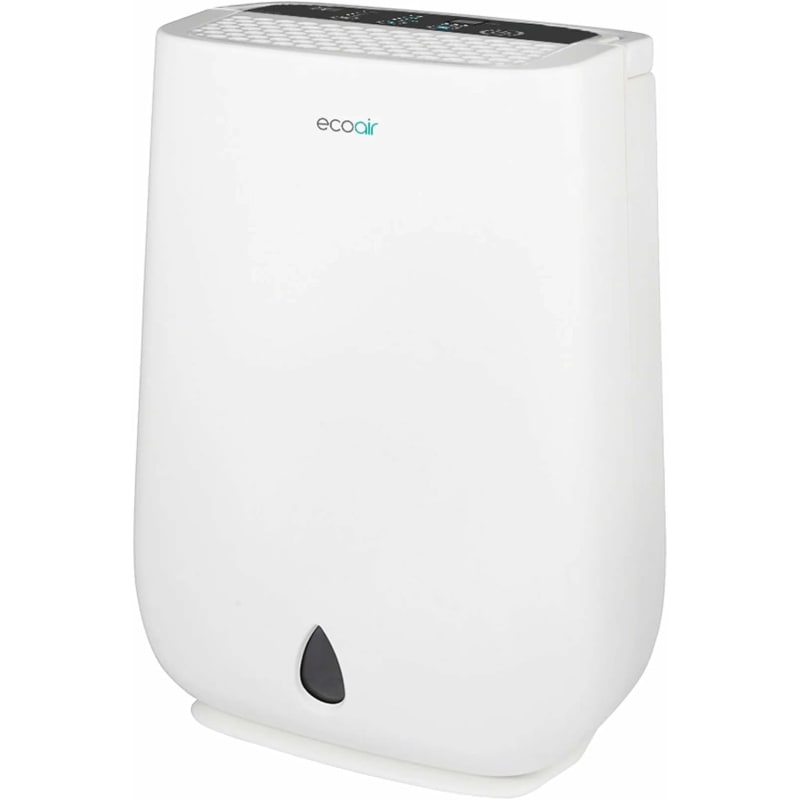
EcoAir DD3 Classic MK3 Desiccant Dehumidifier
A quiet desiccant dehumidifier with a digital humidistat that keeps working in cold rooms, best for a garage, conservatory, cold bedroom or a winter damp problem where a compressor unit gives up.

Dimplex EverDri 20L Dehumidifier
A conventional 20L-class dehumidifier with a clear humidistat and comfort light, from a brand most UK buyers recognise — fine for a large room, but check the real-world capacity and the small tank before you buy.
Best Dehumidifier for Garage UK: the short list
- Top rated: Bosch Dry 4000 Dehumidifier (4.7/5).
- Most extraction: Dimplex EverDri 20L Dehumidifier (20 litres/day (at 30°C and 80% RH)).
- For cold rooms below about 10°C: Meaco DD8L Desiccant Dehumidifier, a desiccant model.
- Size the unit to the room, and check the tank size against how often you are willing to empty it.
| Model | Type | Capacity | Tank | Noise | Rating |
|---|---|---|---|---|---|
| Bosch Dry 4000 Dehumidifier | Compressor | 16 litres/day | 2.5 litres | 38 dB(A) | 4.7/5 |
| Ebac 2650E 18 Litre Dehumidifier with Air Purification and Laundry Mode | Compressor | 18 litres/day | — | — | 4.6/5 |
| Meaco DD8L Desiccant Dehumidifier | Desiccant | 8 litres/day | 2 litres | 39 dB(A) | 4.6/5 |
| EcoAir DD1 Simple MK3 Desiccant Dehumidifier | Desiccant | 7.5 litres/day (rated at low temperature) | 2 litres | 34 dB(A) | 4.6/5 |
| EcoAir DD3 Classic MK3 Desiccant Dehumidifier | Desiccant | Around 10.5 litres/day (marketed as 11L) | 4.2 litres, with cover | 36 dBA | 4.6/5 |
| Dimplex EverDri 20L Dehumidifier | Compressor | 20 litres/day (at 30°C and 80% RH) | 3 litres | 42-46 dB (varies by listing) | 4.0/5 |
Why a garage needs a different dehumidifier to a bedroom
A garage is not just a colder version of a bedroom — it's a different engineering problem, and the single variable that decides which dehumidifier actually works there is temperature, not size or budget. Most UK garages are integral or attached but unheated, and regularly sit at or below 10°C for the entire October-to-April stretch. That single fact rules out the majority of standard compressor dehumidifiers before you even look at capacity or price, because a compressor unit pulls moisture out of the air by passing it over a cold coil — and once room temperature drops much below 10°C, moisture starts freezing onto that coil faster than it can drain away, building a layer of frost that steadily kills extraction performance until the unit is doing next to nothing.
The second thing that changes in a garage is how often you're actually there to notice a problem. A dehumidifier in a bedroom gets walked past daily — a full tank gets emptied within hours. A dehumidifier in a garage might go unvisited for a week at a time, during which a full tank means the unit has simply switched itself off and humidity has climbed straight back up, undoing days of work. That makes continuous drainage a near-requirement for garage use, not a nice-to-have.
The stakes are also different. A damp bedroom is uncomfortable. A damp garage causes measurable financial damage: rust forming on hand tools and power tool bodies, corrosion on a stored car's bodywork and undercarriage, mould on cardboard boxes and stored soft furnishings, and — in a garage doubling as a workshop — damage to anything with exposed bare metal. Getting the right type of dehumidifier in place, at the right target humidity, is worth doing properly rather than reaching for whatever's cheapest.
Desiccant vs compressor: the choice that actually matters here
Desiccant dehumidifiers work on a completely different principle to compressor units, and it's the reason they dominate every genuine cold-garage recommendation. Instead of condensing moisture on a cold coil, a desiccant unit draws air through a slowly rotating wheel coated in a moisture-absorbing material (silica gel), then heats that section of the wheel to release the captured water into a warm airstream that's ducted into the tank. Because this process doesn't rely on a temperature differential between a cold coil and the room, desiccant extraction stays effective down to around 1°C — a genuinely cold British garage in the depths of winter — where a compressor unit has usually stopped doing anything useful.
Of the models we've sourced, the Meaco DD8L and EcoAir DD1 Simple MK3 are both desiccant units built for exactly this scenario. Their rated extraction (8L/day and 7.5L/day respectively) looks modest next to a 20L compressor unit's headline figure, but that headline figure is measured at 30°C — in a genuinely cold, unheated garage a compressor unit's real extraction rate collapses well below its rating, while a desiccant unit's holds far more consistently. In practice, a desiccant unit is often the faster choice in a cold space despite the lower number on the box.
Compressor units aren't wrong for every garage — they're wrong specifically for a cold, unheated one. If your garage is integrated into a heated house and stays reliably above 15°C, or you've got a wall heater running in a workshop garage, a compressor unit becomes the more efficient choice: it draws meaningfully less power than a desiccant unit doing the same job in warm conditions. The Ebac 2650E, with Intelligent Defrost rated to 3°C, sits in an unusual middle ground — a compressor unit engineered specifically to keep working through a cold snap that would stop a standard compressor model, though it still won't match a desiccant unit's consistency at true winter-garage temperatures below freezing. The Bosch Dry 4000 is a standard compressor unit best reserved for a garage that's reliably heated year-round.
The models we've sourced for garage use
Cold, unheated garage (most UK garages, October-April especially): the Meaco DD8L is our top pick — 8L/day desiccant extraction, works effectively well below 10°C, continuous drainage option fitted as standard, and a laundry mode if the garage doubles as a drying space. The EcoAir DD1 Simple MK3 is the value alternative — 7.5L/day, quieter at 34dB, rated 1°C to 35°C, with a 3-year warranty and an antibacterial filter, at a typically lower price than the Meaco.
Heated or reliably warm garage, workshop or integral garage (above 15°C year-round): the Ebac 2650E brings genuine cold-weather headroom (Intelligent Defrost to 3°C) as a safety margin even in a nominally heated space that occasionally dips, plus an 8-hour laundry boost and air purification mode. The Bosch Dry 4000 is the more affordable compressor option for a garage that's consistently warm, rated for rooms up to 33m² with Auto, Night and Laundry modes.
Which one for you: check your garage's coldest realistic winter temperature before anything else. If you genuinely don't know, assume it's unheated and buy desiccant — a desiccant unit works fine in a warm garage too, it's simply less power-efficient there than a compressor model, whereas a compressor unit in a cold garage can end up doing almost nothing for months at a time.
What it actually costs to run one in a garage
Running a dehumidifier continuously in a garage over an entire winter is a genuinely different cost proposition from occasional bedroom use, simply because of the hours involved — so it's worth working through properly rather than guessing. The Meaco DD8L draws roughly 30W on its low fan speed and up to around 330-650W on medium/high, translating to a low-speed running cost in the low single-digit pence per hour bracket at current UK electricity rates, rising meaningfully if it's regularly cycling on higher speeds to keep up with a persistently damp space. The EcoAir DD1 Simple MK3 draws a flatter 300-580W across its speed range, since it uses a simpler rotary control rather than Meaco's intelligent cycling logic — in practice this usually means slightly higher running costs for comparable results, though the gap narrows once Energy Saving mode is factored in.
The bigger cost driver isn't the model you pick, it's how the unit is controlled. A dehumidifier left on a fixed "always on, full power" setting in a garage runs up a bill fast regardless of brand. One set to a humidistat target — 50% RH for most garage use cases — and left to cycle on and off automatically costs a fraction of that, because it only draws meaningful power when humidity has actually risen above target. Over a full UK winter (October to March), expect a well-controlled desiccant unit in a moderately damp single garage to cost somewhere in the region of £15-£40 in electricity, against the cost of the alternative — rusted tools, a corroded car, or mould-damaged stored goods — which is rarely a close call either way.
Compressor units in a genuinely heated garage compare favourably here: the Bosch Dry 4000 at around 285W and the Ebac 2650E with its Smart Technology auto on/off sensing (Ebac's own figure is up to £50/year saved versus continuous humidistat-free running) are both more power-efficient than a desiccant unit doing equivalent work in warm conditions — the efficiency case for desiccant technology is specifically about cold-weather reliability, not about being universally cheaper to run.
Signs your garage actually needs a dehumidifier
Visible rust appearing on tools or metal shelving that weren't rusty when stored is the clearest sign humidity is already too high — by the time rust is visible, the garage has likely been sitting above 60% RH for some time. Condensation on the inside of windows or on a car's bodywork first thing in the morning, even when the car itself is dry, points to the same underlying problem. A musty or damp smell that's noticeable as soon as you open the door, particularly if it's stronger than the smell outside, usually means mould or mildew has already started on cardboard, fabric or timber somewhere in the space.
Cardboard boxes going soft or developing a warped, damp texture at the bottom is a slower-moving but very reliable indicator — cardboard absorbs ambient moisture readily and shows the effect well before it's obvious anywhere else in the garage. A hygrometer reading consistently above 65% RH, if you've got one placed in the space, removes the guesswork entirely and is worth the roughly £10-£15 investment before committing to a dehumidifier purchase, since it also lets you confirm the unit is actually bringing the reading down once installed.
If a car is stored in the garage over winter and you notice the battery struggling to hold charge, electrical connectors corroding, or the interior smelling musty after a few weeks unused, that's usually a humidity problem reaching the vehicle itself rather than anything mechanically wrong with the car — a strong argument for a desiccant unit running continuously in that space through the coldest months.
What to check before buying a garage dehumidifier
Target humidity. Aim for 45-50% RH to protect bare metal tools and machinery from rust — corrosion on unprotected metal all but stops below roughly 60% RH, and 50% leaves a comfortable margin. If the garage stores a car, 50-55% RH balances rust prevention on bodywork against leather and rubber components drying out and cracking below 40% RH. For general stored goods — cardboard, fabric, furniture — 40-55% RH avoids both mould (needs sustained humidity above ~70%) and the musty smell that sets in above 60%.
Continuous drainage. Every desiccant model we recommend for garage use ships with a drain hose. Route it to a nearby gully, an outside edge with a suitable fall, or a bucket you commit to checking regularly — a condensate pump (roughly £30-£50) is worth considering if no gravity-fed drainage point is within reach, since it can lift water a metre or more to a suitable outlet.
Wall-mounting. The Meaco DD8L supports wall mounting (bracket sold separately), which keeps the unit off the floor, clear of vehicles and equipment, and out of the way in a space that's often tight on floor room. Worth factoring into the buying decision if garage floor space is at a premium.
Placement. Position centrally where possible, with clearance on at least two sides for airflow, away from the main door — every time a garage door opens, a wave of humid outdoor air enters, and a unit positioned right next to the door spends more of its cycle fighting fresh moisture ingress than clearing the existing air.
Filter maintenance. A garage accumulates dust, oil residue and general workshop debris faster than a living space. Check and clean the filter more frequently than the standard 2-4 week indoor guideline — every 2-3 weeks is a sensible starting point for an active workshop garage.
Cellars, sheds and outbuildings: the same logic applies
Everything above holds for a cellar, shed or any other unheated outbuilding — the deciding factor is temperature, not the specific label on the space. A cellar is often colder and more consistently damp than a garage, since it sits below ground level with less air movement and frequently no natural ventilation at all; the Meaco DD8L or EcoAir DD1 Simple MK3's desiccant technology is the right starting point there too, and a cellar's typically smaller footprint often means a single unit covers it more completely than a larger garage.
A garden shed used for tool storage faces an even harsher swing between a baking-hot summer interior and a freezing winter one — desiccant technology's consistency across that whole range matters more here than in almost any other application on this site. Given a shed's usually limited power access, check the EcoAir DD1 Simple MK3's lower running wattage on its lowest setting against your available circuit before committing to a unit.
A static caravan or boat left unattended over winter is arguably the most extreme version of this problem — genuinely freezing temperatures, zero daily visits, and real damage (mould, mildew, seized mechanisms) if moisture is left unchecked for months. Continuous drainage isn't optional here; without it, a full tank early in the off-season means the space runs unprotected for the rest of winter.
What garage and cellar owners say
Our verdict draws on the pattern across verified Amazon.co.uk reviews for each model, cross-checked against the manufacturer specifications — the same approach we use across every pillar on this site.
The most repeated theme across desiccant reviews specifically mentioning garage, cellar, shed or caravan use is reliability through cold spells — owners consistently note that the unit kept pulling water even during the coldest weeks of winter, when a previous compressor dehumidifier they'd tried had visibly stopped doing anything. The Meaco DD8L in particular draws praise for its continuous drain hose making it genuinely "set and forget" for weeks at a time in a space that isn't visited daily.
The most repeated criticism, again specific to unattended cold-space use, is the small 2L tank size on both desiccant models compared here — several reviewers note that without connecting the drain hose from day one, the tank fills faster than expected in a genuinely damp garage, defeating the point of an unattended setup. Reviewers who connected the drain hose immediately don't report this as an issue, which lines up with our own buying-guide recommendation above to treat continuous drainage as a near-requirement rather than optional extra for this specific use case.
Which dehumidifier for a garage should you buy
If your garage is unheated (true for most UK garages through winter), buy the Meaco DD8L — desiccant technology that keeps working regardless of temperature, continuous drainage as standard, and a genuine track record on this exact use case.
If budget is the deciding factor and your garage is also unheated, the EcoAir DD1 Simple MK3 delivers comparable cold-weather performance for typically less money, with the trade-off of simpler rotary controls rather than Meaco's intelligent cycling logic.
If your garage is reliably heated above 15°C, a compressor unit is the more efficient choice — the Ebac 2650E if you want cold-weather headroom as a safety margin, or the Bosch Dry 4000 for a straightforward, more affordable option in a consistently warm space.
For a cellar, shed or unattended caravan, apply the same unheated-space logic — desiccant technology and continuous drainage first, compressor units only once you're certain the space stays warm year-round. See our full best dehumidifier UK comparison for every model we've sourced if none of these quite fit your situation.
Frequently asked questions
Can I use a normal home dehumidifier in my garage?+
Only if the garage stays reliably heated above 15°C year-round. Standard compressor dehumidifiers lose most of their extraction efficiency below 15°C and provide minimal protection below 5°C — for an unheated UK garage, a desiccant model like the Meaco DD8L or EcoAir DD1 Simple MK3 is the right choice, since both keep working effectively down to around 1°C.
How long does it take a dehumidifier to dry out a damp garage?+
In a moderately damp single garage, expect humidity to drop to the 50% target within roughly 24-48 hours of continuous running. If walls, the concrete floor or stored items have absorbed significant moisture over years, it can take several weeks of gradual release from the building fabric before humidity fully stabilises.
What size dehumidifier do I need for a garage?+
For a standard single UK garage (roughly 14-20m²), the Meaco DD8L (8L/day) or EcoAir DD1 Simple MK3 (7.5L/day) are appropriately sized for an unheated space. For a double garage or a heated workshop with a bigger damp problem, a higher-capacity compressor unit like the Bosch Dry 4000 or Ebac 2650E is worth considering, provided the space stays warm enough for a compressor to work efficiently.
Will a dehumidifier stop my tools from rusting?+
Yes, when the garage is maintained below roughly 50-55% RH — rust and corrosion on bare metal need both moisture and oxygen, and keeping humidity down removes the moisture side of that equation. It won't reverse rust that's already formed; it only prevents further corrosion going forward.
Do I need to empty the tank myself in a garage dehumidifier?+
Ideally not — connect the included drain hose to a nearby gully, drain or bucket you check regularly. In a garage you don't visit daily, a full tank means the unit switches itself off, often for days at a time, undoing the progress already made. Continuous drainage avoids that failure mode entirely.
Is a dehumidifier for a cellar the same as one for a garage?+
The buying logic is identical — temperature is the deciding factor, not the label on the room. A cellar is often colder and damper than a garage with even less natural ventilation, so the same desiccant models (Meaco DD8L, EcoAir DD1 Simple MK3) that suit an unheated garage are usually the right starting point for a cellar too.
Sources and further reading
Related searches
Best dehumidifier for a shed UK
A garden shed swings between a baking summer interior and a freezing winter one, so the same desiccant technology recommended for a garage — the EcoAir DD1 Simple MK3 or Meaco DD8L — is the right starting point, since both keep working across that whole temperature range. Check the shed's available power circuit against the unit's wattage before buying, since sheds are often on a limited supply.
Dehumidifier for an attic or loft — does the cold rule out a compressor unit?
Yes, in most UK lofts over winter. An unheated attic sees the same sub-10°C temperatures as a garage for much of the year, so a desiccant model like the Meaco DD8L is the safer choice — a standard compressor unit will likely do very little up there from October to March.
Best dehumidifier for a caravan or boat left over winter
This is the scenario continuous drainage was designed for — genuinely cold conditions and no daily visits to empty a tank. The Meaco DD8L's included drain hose, routed to a suitable outlet, keeps it running unattended for weeks at a time, which matters far more here than in a garage you might still check every few days.
Related buying guides
Explore more dehumidifier guides
26 dehumidifiers compared · Amazon.co.uk prices checked October 2026